
A practical notebook on Fish Genetics and Breeding
- Reference
- AU/DEx/502-Bl/07/2026
- Published
- 5 Aug 2026
Information & Publication Section
SKUAST-Kashmir
About this publication
Summary
AU/DEx/502-Bl/07/2026
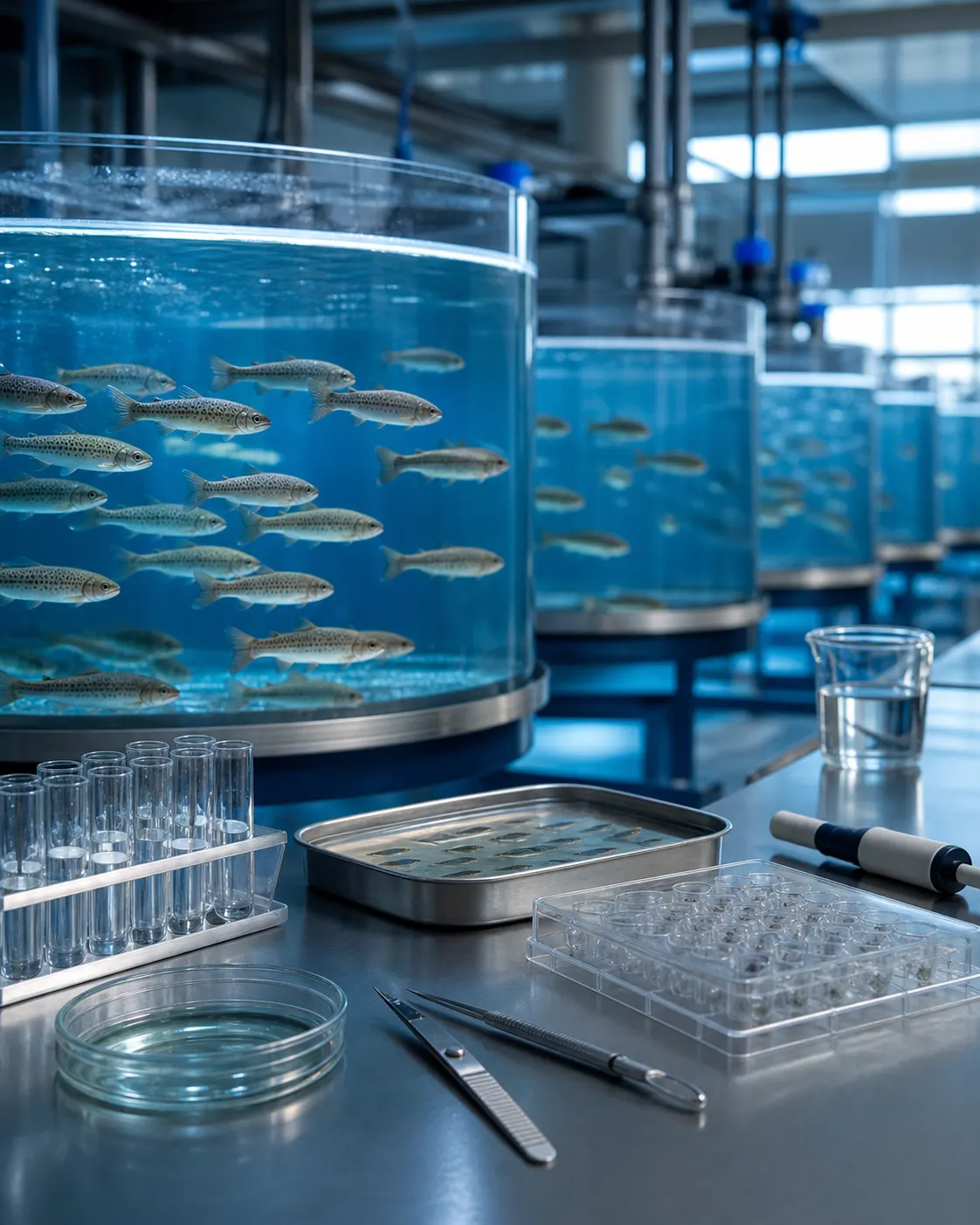
A Practical Notebook on Fish Genetics and Breeding is a comprehensive laboratory manual designed to provide undergraduate and postgraduate students of fisheries and aquaculture with practical knowledge and hands-on experience in the principles of fish genetics, breeding, and reproductive biotechnology. The booklet integrates fundamental genetic concepts with laboratory exercises and numerical problems, enabling students to understand both the theoretical and practical aspects of fish breeding programs. The notebook begins with the fundamentals of Mendelian genetics, including monohybrid and dihybrid inheritance, test crosses, and epistasis, using examples from economically important and model fish species such as zebrafish, guppy, goldfish, medaka, and rainbow trout. It further introduces quantitative genetics by explaining heritability, response to selection, variance, and selective breeding strategies, which are essential for improving economically important traits such as growth, disease resistance, and reproductive performance in aquaculture. A major strength of the booklet is its emphasis on practical breeding and conservation genetics. It includes detailed exercises on estimating inbreeding, heterosis, gene and genotype frequencies, and Hardy–Weinberg equilibrium, helping students understand genetic diversity and its importance in sustainable broodstock management. The manual also provides comprehensive laboratory protocols for chromosome preparation, induced gynogenesis, polyploidy induction, gamete cryopreservation, and fish milt quality evaluation, introducing students to modern cytogenetic and reproductive technologies widely used in fisheries research. Each practical consists of a brief introduction, worked examples, step-by-step calculations or laboratory procedures, and student exercises that reinforce learning through problem-solving. The inclusion of real-world examples from aquaculture and fish breeding programs makes the concepts easy to understand and directly applicable to hatchery management and selective breeding initiatives. Overall, this practical notebook serves as an excellent teaching and laboratory resource for students, researchers, and professionals in fisheries science. It bridges the gap between classroom learning and laboratory practice, promotes analytical thinking, and equips learners with the skills required for modern fish genetics, breeding, conservation, and aquaculture research. By combining classical genetics with contemporary biotechnological approaches, the booklet provides a strong foundation for improving fish production, conserving aquatic biodiversity, and advancing sustainable aquaculture.
- Subject area
- FISH GEENTICS AND BREEDING
- Language
- English
- Keywords
- FISH, GENE, HERTABILITY, FREQUENCY
People behind the work
Contributors
Irfan Ahmad BhatCorresponding
SKUAST K
Mohd Ashraf Rather
Irfan Ahmad Khan